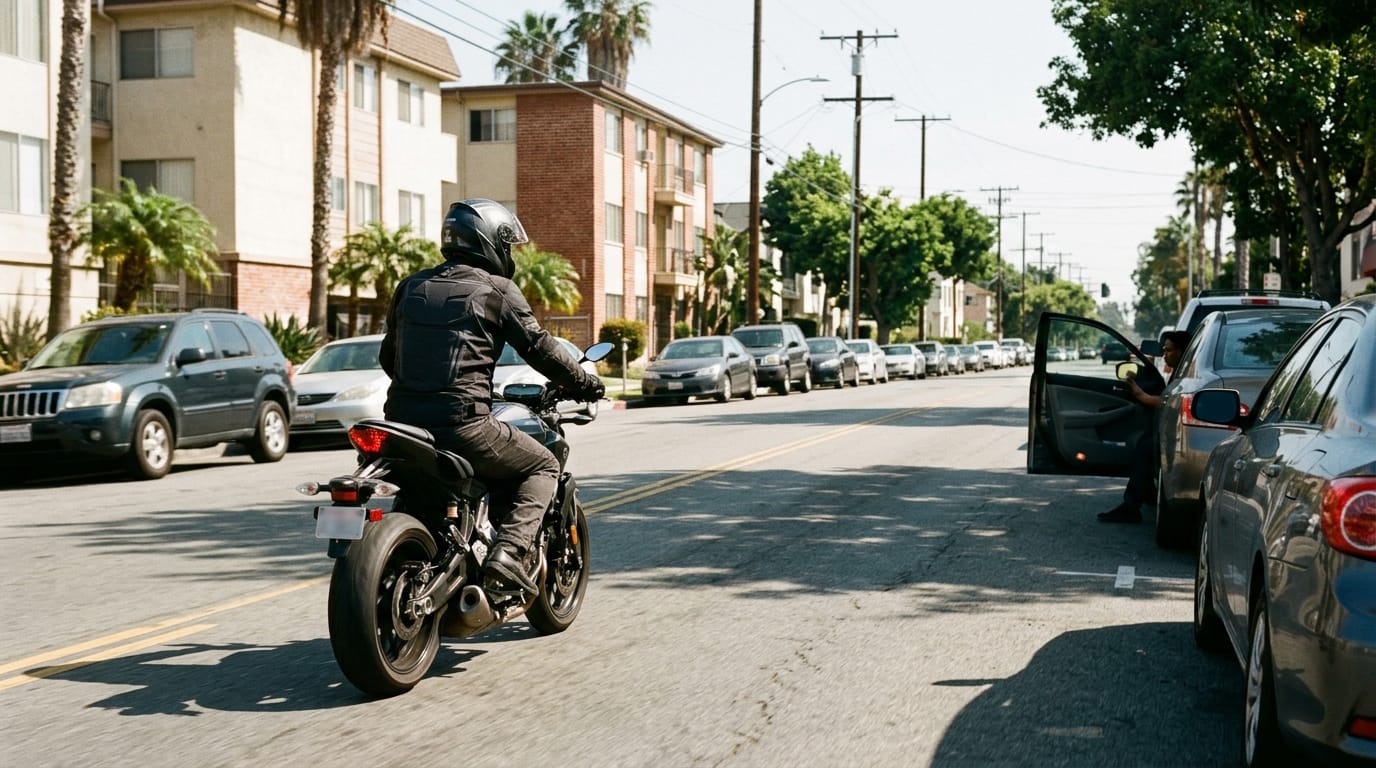
Motorcycle dooring accidents in California can happen when a driver or passenger opens a parked vehicle’s door directly into the path of an approaching motorcyclist. Although these collisions may occur at relatively low speeds, they can cause serious injuries because riders have little physical protection from the impact.
In 2026, understanding motorcycle dooring liability remains important as riders navigate crowded urban streets, commercial districts, delivery zones, and areas with parallel parking. A motorcycle may be traveling lawfully when a vehicle occupant suddenly opens a door, leaving the rider with little time to brake or avoid a collision.
California Vehicle Code Section 22517 addresses this danger. The law generally prohibits opening a vehicle door on the side available to moving traffic unless doing so is reasonably safe and does not interfere with traffic movement.
For injured riders, this rule may become relevant when determining fault. However, a violation does not automatically establish every element of a successful personal injury claim. Investigators must still consider causation, available evidence, and whether another person’s actions contributed to the crash.
This article explains how motorcycle dooring accidents happen, how California law applies, which injuries may result, and what evidence can help injured motorcyclists document their claims.
Why Motorcycle Dooring Accidents Happen and Who May Be Responsible
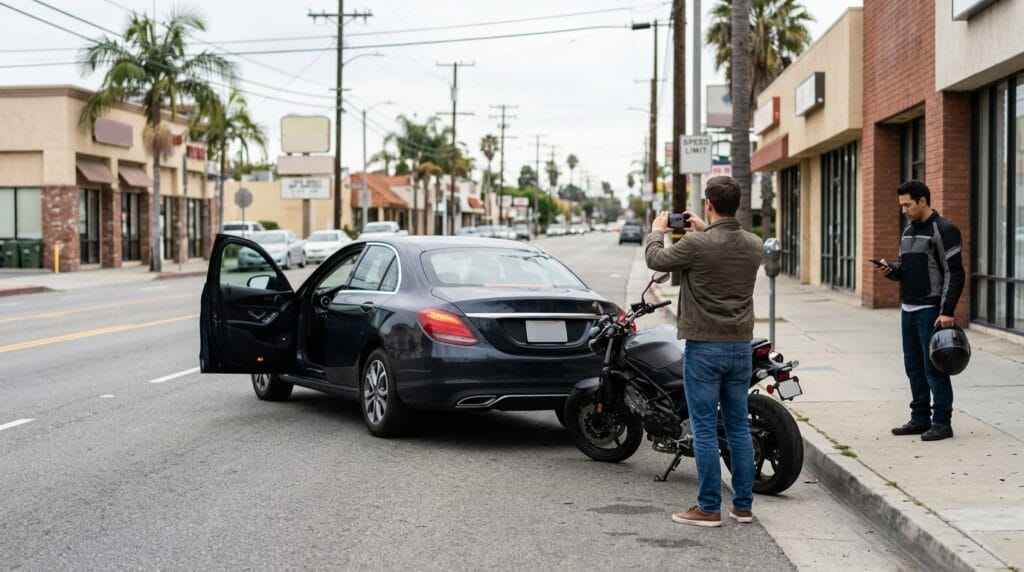
A dooring collision usually begins with a parked vehicle. Someone inside opens a door without fully checking for approaching traffic. A rider passing nearby may strike the door, swerve into another vehicle, or lose control while attempting to avoid the obstruction.
These situations are particularly dangerous on streets where parked vehicles sit immediately beside an active travel lane. The space between moving traffic and parked cars may leave little room for evasive maneuvers.
Drivers and passengers should check mirrors, look toward approaching traffic, and confirm that the door can be opened without creating danger. Motorcyclists should also remain alert near parked vehicles, especially when occupants are visible inside.
Nevertheless, a motorcyclist’s responsibility to ride carefully does not eliminate the legal duties imposed on people opening vehicle doors.
California Vehicle Code Section 22517 and the duty to check traffic
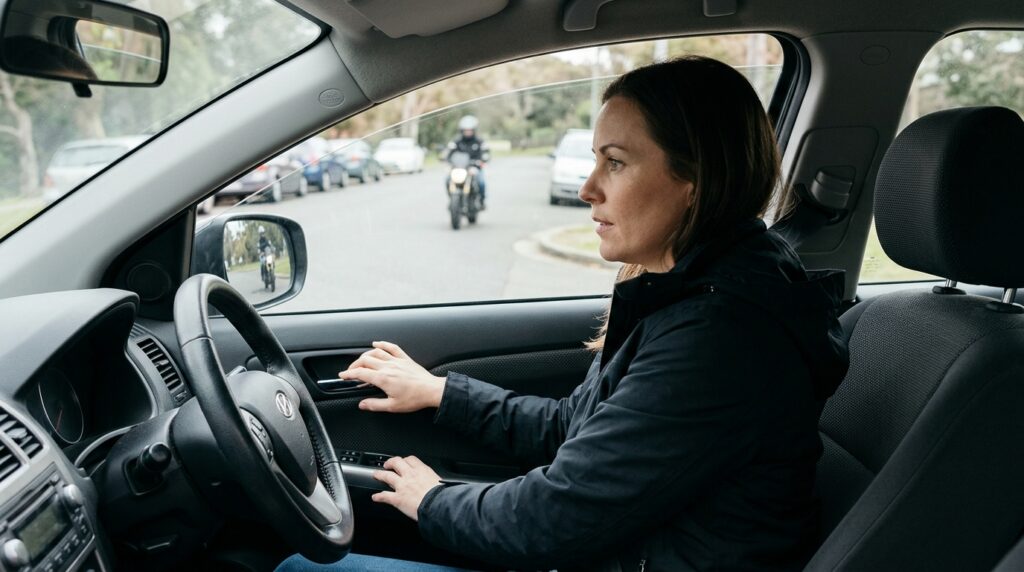
California Vehicle Code Section 22517 establishes an important rule concerning vehicle doors opened toward moving traffic. A person must not open a door on the traffic side unless the action is reasonably safe and does not interfere with traffic movement.
The statute also restricts leaving a door open on the traffic side longer than necessary for loading or unloading passengers.
This requirement applies to people opening vehicle doors, including passengers. The legal analysis is not necessarily limited to the person driving the parked automobile.
Consider a motorcycle approaching a vehicle parked beside a city street. If a passenger suddenly opens the door without looking, the rider may have only a fraction of a second to react.
Investigators may examine whether the person opening the door had an adequate view of approaching traffic and whether there was a reasonable opportunity to avoid creating the hazard.
When a driver or passenger opens a door without looking
A person preparing to exit a vehicle should check mirrors and look for approaching road users before opening the door. Motorcycles and bicycles can be less visually prominent than larger vehicles, especially when traffic is heavy.
If someone opens a door directly into an occupied traffic lane, that action may support an allegation of negligence. Relevant evidence includes the door’s position, visibility, nearby traffic, and the timing of the motorcyclist’s approach.
However, liability remains fact-specific. The investigator must determine whether the unsafe door opening contributed to the impact and resulting injuries.
Our article about motorcycle visibility and driver awareness in 2026 explains why motorists should actively look for riders before entering or interfering with traffic.
Can a motorcyclist share fault for a dooring collision?
California follows a pure comparative negligence system. A rider may recover damages even when partially responsible for an accident, although the amount may be reduced according to the rider’s assigned percentage of fault.
For example, an investigation could find that a vehicle occupant opened a door without checking traffic while the motorcyclist was traveling at an unsafe speed. Both actions may require evaluation.
Insurers may also question the rider’s lane position, attentiveness, and ability to avoid the collision. Those arguments should be tested against physical evidence rather than accepted automatically.
Our existing guide to motorcycle lane filtering accident claims discusses how differences in traffic laws can influence liability arguments.
It is important to distinguish legal lane splitting from riding along a parking lane or shoulder. California’s lane-splitting rules do not automatically authorize every maneuver around parked vehicles.
Common injuries caused by motorcycle dooring accidents
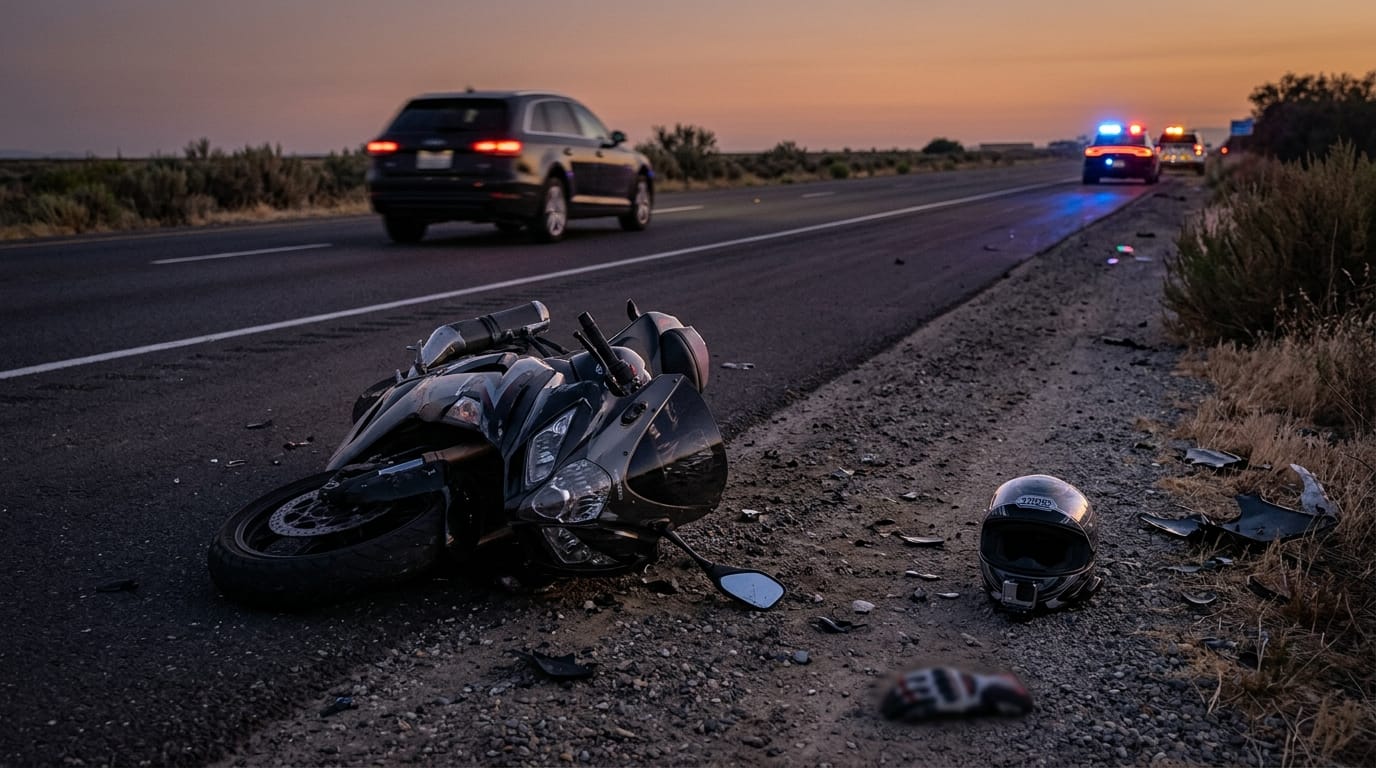
Motorcyclists face significant injury risks when striking an unexpectedly opened door. The front wheel, handlebars, or rider’s body may contact the door before the motorcycle falls onto the pavement.
Potential injuries include wrist fractures, shoulder dislocations, broken collarbones, knee trauma, spinal injuries, and head injuries. Abrasions and road rash may occur when the rider slides across the roadway.
Some injuries become apparent immediately, while others require imaging or medical examination to identify. A rider who initially stands up after a collision may still have a fracture, concussion, or other serious injury.
The impact may also push the motorcycle into an adjacent lane, creating the possibility of a secondary collision.
Why head, shoulder, and wrist injuries deserve attention
A rider may instinctively extend an arm to reduce the force of a fall. This can place substantial stress on the wrist, forearm, elbow, and shoulder.
Head trauma is another serious concern. Even when a helmet is worn, a motorcycle collision may cause a concussion or other traumatic brain injury.
Symptoms such as repeated vomiting, worsening headache, confusion, weakness, or loss of consciousness require emergency medical attention.
Protective equipment can reduce certain risks but cannot eliminate every injury. Medical findings, treatment records, and rehabilitation documentation may be essential when evaluating the consequences of a crash.
How to Prove Fault and Protect a Motorcycle Dooring Accident Claim
Establishing liability after a dooring accident may be difficult when the parties provide different accounts. A driver or passenger might claim the door was already open, while the motorcyclist may explain that it entered the riding path suddenly.
Physical evidence can help determine what happened. Damage to the motorcycle, the car door, and nearby objects may reveal the approximate impact location and direction of movement.
Photographs should document the scene from several perspectives, including the rider’s approach, the parked vehicle’s position, and the available width of the travel lane.
Street markings, parking restrictions, visibility conditions, and nearby intersections may also become relevant.
After any serious collision, medical care and immediate safety should take priority over collecting evidence.
Evidence that can help reconstruct a dooring collision
Helmet cameras, motorcycle-mounted cameras, dashcams, and nearby business surveillance systems may capture the seconds before a vehicle door opens.
Video can be especially useful when determining whether the door opened suddenly or remained in the rider’s path for a longer period.
Witness statements may provide additional information about traffic conditions and the actions of both parties.
Investigators may also examine damage patterns, vehicle positions, road measurements, and photographs taken immediately after the incident.
Some modern vehicles have electronic safety features that warn occupants about approaching cyclists or other road users. However, these systems vary by model, and their presence or operation should not be assumed without specific evidence.
Documentation should focus on what can actually be established rather than speculation about technology or driver intent.
What to do immediately after a motorcycle dooring accident
First, move out of active traffic if doing so is safe and does not worsen any injuries. Call emergency services when the collision causes serious injuries or creates an immediate roadway hazard.
Seek medical evaluation for significant pain, head impacts, numbness, weakness, or other concerning symptoms.
When safe, photograph the motorcycle, opened door, pavement markings, parked vehicle, nearby signs, and visible injuries.
Collect contact information from the vehicle occupant and any witnesses. Preserve helmet-camera recordings and avoid editing original video files.
Report the incident to the appropriate authorities and notify relevant insurers according to applicable requirements.
Avoid guessing about vehicle speeds or accepting responsibility before the facts have been investigated.
Medical records, repair estimates, photographs, and employment documentation may help establish the financial and physical consequences of the accident.
For broader guidance concerning motorcycle injury evidence, review our article on motorcycle road hazard accident claims. Although road defects involve different legal questions, both types of claims require careful reconstruction and evidence preservation.
California Evidence Code Section 669 may be relevant when a violation of a traffic safety statute is alleged. Under qualifying circumstances, a statutory violation can support a presumption of negligence.
Nevertheless, the injured person must still establish the required connection between the conduct, the collision, and the resulting harm. A traffic citation alone does not determine the amount of damages.
California personal injury lawsuits
Available compensation may include reasonable medical expenses, lost income, future treatment costs, property damage, and non-economic losses such as pain and suffering when supported by applicable law and evidence.
For many California personal injury lawsuits, Code of Civil Procedure Section 335.1 generally establishes a two-year filing period. Exceptions and shorter deadlines may apply, particularly when a public entity is involved.
Because surveillance recordings may be overwritten and vehicles may be repaired, preserving relevant evidence should begin promptly.
The California Highway Patrol’s motorcycle safety guidance recommends avoiding blind spots, anticipating unexpected vehicle movements, and maintaining awareness of road conditions.
For riders, prevention includes watching for occupants inside parked vehicles, maintaining appropriate clearance, and reducing speed when the available roadway space becomes narrow.
Drivers and passengers can help prevent dooring collisions by checking mirrors, looking over their shoulders, and opening vehicle doors only when it is safe.
Motorcycle dooring accidents in California remain an important safety and legal concern in 2026. A seemingly routine action, such as opening a car door, can have life-changing consequences for an approaching rider.
Understanding California Vehicle Code Section 22517, preserving evidence, obtaining appropriate medical care, and evaluating comparative fault can help clarify the circumstances of a motorcycle injury claim.
Disclaimer: This article provides general educational information and does not constitute legal advice. The outcome of any motorcycle accident claim depends on its facts, applicable law, and available evidence.