
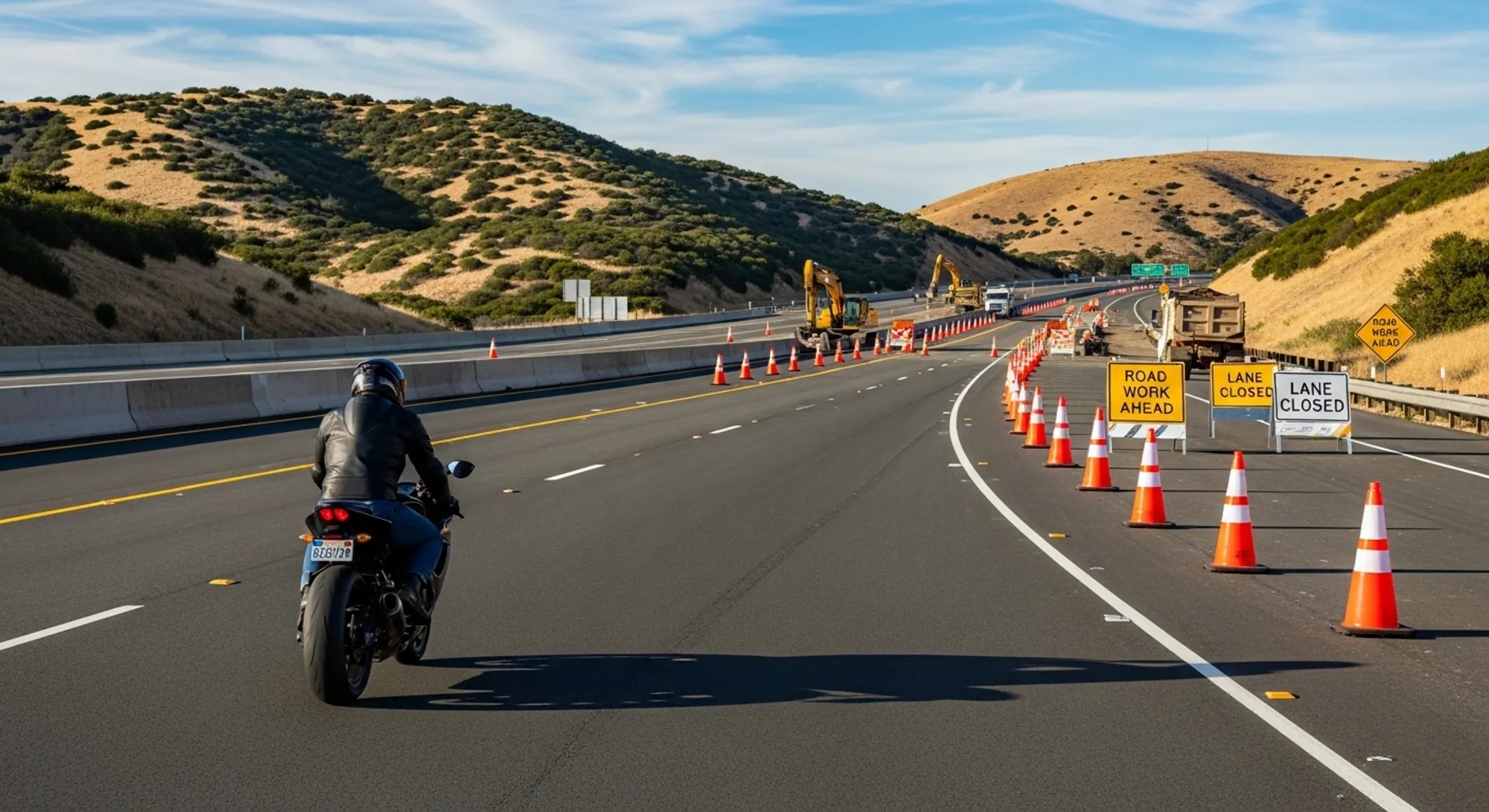
Construction zones create serious risks for motorcyclists. What feels manageable in a car can become dangerous on two wheels. Loose gravel, uneven pavement, narrow lanes, and sudden stops reduce your margin for error.
In 2026, construction zone motorcycle accidents in California continue to rise. Many of these crashes involve more than one cause. A driver may make a mistake, but unsafe road conditions often play a role too.
That is what makes these cases different. The real issue is not just what happened. You must ask who created the risk, who ignored it, and who failed to fix it.
If you want a deeper look at road-related dangers, see our guide on motorcycle road hazard accidents in California.
Why construction zones are uniquely dangerous for motorcycle riders
Construction zones change how the road behaves. Riders must adjust quickly. The problem is that these changes often happen without enough warning.
Sudden road condition changes
Riders may move from smooth pavement to rough surfaces within seconds. Temporary markings can confuse lane positions. These fast transitions increase crash risk.
Common crash scenarios in construction zones
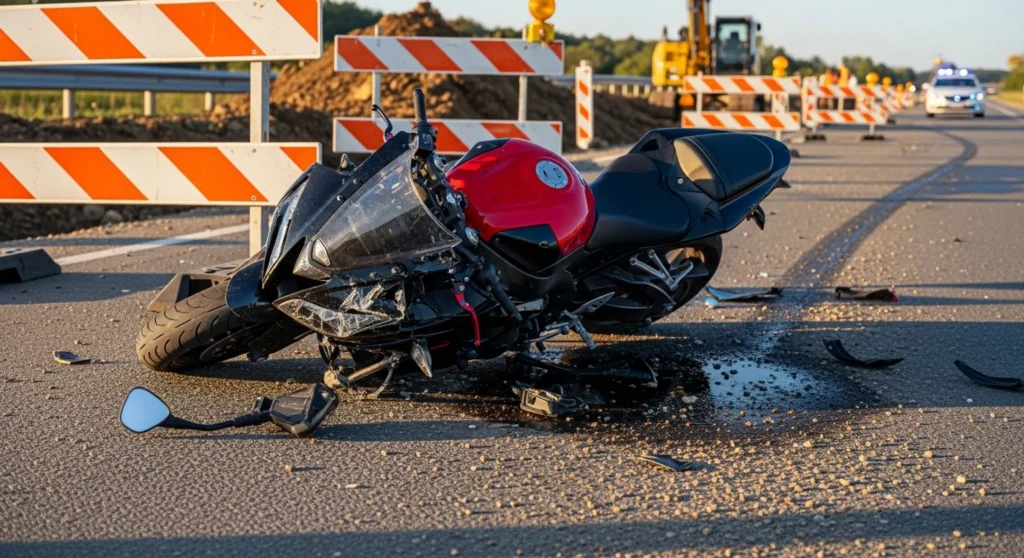
Most crashes happen due to a chain of small problems. A driver brakes suddenly. A rider swerves. The motorcycle hits debris or an uneven surface.
Loose gravel and debris
Loose materials destroy traction. Even experienced riders can lose control instantly when tires slide.
Uneven pavement transitions
Raised edges between lanes can destabilize a motorcycle. A simple lane change can turn into a crash.
Poor signs and traffic control
Missing or confusing signs lead to sudden movements. Drivers and riders react late, which increases collision risk.
Driver behavior also makes things worse. Speeding, distraction, and unsafe lane changes become more dangerous in tight work zones.
For example, visibility issues also play a role in left-turn motorcycle accidents, where drivers often fail to see riders.
Why fault is rarely simple
These crashes rarely involve one cause. A driver may act carelessly. At the same time, the construction zone may be unsafe.
Contractors control the setup. Government agencies approve projects. Workers maintain the area. Any of these parties may share responsibility.
Who may be liable and what evidence can make or break the claim
Evidence determines the outcome of most construction zone cases. The challenge is that the scene changes fast. Crews move cones, clean debris, and repair surfaces quickly.
Potentially liable parties
A negligent driver
A driver who speeds, merges unsafely, or follows too closely may cause the crash. Many drivers claim they did not see the motorcycle, but that does not remove liability.
Construction companies may also be responsible. They must keep the area safe. Poor setup, missing warnings, or leftover debris can create dangerous conditions.
Government agencies may share liability if they failed to address a known hazard. Maintenance crews and subcontractors may also play a role.
In some cases, equipment failure contributes to the crash. If that happens, review issues like defective parts in motorcycle defect-related accidents.
Critical evidence to collect
Photos and video
Take clear photos of the scene immediately. Capture cone placement, road conditions, signage, and debris. These details often disappear within hours.
Camera footage
Helmet cams and dashcams provide strong proof. They show speed, visibility, and how the crash happened in real time.
Learn more about this in our guide on AI dashcam evidence.
Witness statements
Witnesses can confirm unsafe conditions. They may also show that the hazard existed before the crash.
Medical documentation
Medical records prove the extent of injuries. Even minor crashes can cause serious long-term damage.
For safety guidance, riders can review resources from the California Highway Patrol and NHTSA.
Construction zone motorcycle accidents in California are not simple cases. They often involve multiple failures at once. When the road itself becomes dangerous, liability goes beyond the rider.
If a crash happens in a work zone, act fast. Take photos, save footage, identify witnesses, and seek medical care immediately. Evidence disappears quickly, and timing can decide your case.
Why construction zones are uniquely dangerous for motorcycle riders
Construction areas are not just messy roads. They are temporary traffic environments where normal expectations disappear. Riders may move from smooth pavement to grooved asphalt, from clear lane markings to confusing temporary paint, or from regular traffic flow to abrupt merging in a matter of seconds. On a motorcycle, that sudden change matters a lot.
How these crashes usually happen
Most construction zone motorcycle crashes are not caused by a single dramatic event. They usually happen because several small failures stack together fast. A contractor leaves loose debris near a lane split. A driver ahead brakes suddenly. A rider swerves to avoid a barrel, catches an uneven edge, and goes down. Another common scenario involves a narrowed lane where a driver drifts too close to a rider and forces the motorcycle into cones, barriers, or rough pavement.
Loose gravel and debris
Loose gravel, dust, broken asphalt, nails, and leftover construction material can destroy traction instantly. A rider who would otherwise have stayed upright may slide, fishtail, or lay the bike down just trying to stay clear of the hazard.
Uneven pavement transitions
When one lane sits higher than the next, or when temporary resurfacing leaves a sharp edge, motorcycles are at much higher risk than passenger vehicles. Even a modest height difference can destabilize the bike during a lane change or emergency maneuver.
Poor signs and confusing traffic control
Missing signs, late merge warnings, badly placed cones, or faded temporary striping can confuse both riders and drivers. That confusion increases the odds of sudden braking, unsafe merges, and side-swipe collisions.
Construction zones also magnify ordinary driver negligence. A motorist who is distracted, impatient, speeding, or not checking blind spots becomes even more dangerous in a narrowed lane or shifting traffic pattern. That is one reason riders should also understand how fault works in other crash types, including left-turn motorcycle accidents, where visibility and misjudgment often play a major role.
Why fault is rarely simple
In many motorcycle construction-zone cases, blame does not fall on only one person. The driver who hit the rider may have been negligent, but the work zone itself may also have been unsafe. A public agency might have approved the traffic-control plan. A private contractor may have set up the cones, signage, pavement transition, or closure. A subcontractor may have left debris behind. A maintenance vehicle may have been parked where approaching traffic could not react safely.
That means these cases often require a broader investigation than a basic police report provides. The scene has to be analyzed carefully. Who controlled the area? Who was supposed to inspect it? Were proper warnings in place? Was the lane layout reasonable for motorcycle traffic? Was the hazard temporary, recurring, or already known?
Who may be liable and what evidence can make or break the claim

Construction zone motorcycle accident claims are evidence-driven. The bad news is that the scene can change fast. By the next day, the cones may be moved, the gravel may be swept, the lane markings may be repainted, and the pavement may already be patched. That is why fast documentation matters so much.
Parties that may be responsible
Depending on the facts, several different parties may be legally responsible for the same crash.
A negligent driver
If a car, truck, van, or work vehicle drifted, merged unsafely, followed too closely, or failed to slow down in the work zone, that driver may be directly liable. Motorcycle riders often get unfairly blamed after these crashes, especially when the other motorist claims they “never saw the bike.”
A driver’s fault, however, does not automatically eliminate the role of the work zone itself. Both can matter at the same time.
A construction company or contractor may also be liable if it created an unsafe condition, failed to clean debris, used poor traffic control, or left a dangerous pavement edge unmarked. In other situations, a city, county, or state agency may be part of the case if the roadway was publicly controlled and the dangerous condition should have been corrected or warned about.
There can also be edge cases. If a mechanical issue contributed to the crash, the rider may need to consider whether defective brakes, tires, steering components, or another failed part made the injuries worse. That is where a related article like motorcycle recalls and defect-related accidents in 2026 can strengthen your internal topical authority.
What evidence matters most
The strongest cases are usually built before the scene changes. Riders, families, witnesses, and lawyers should focus on preserving the proof that disappears first.
Photos and video of the roadway are critical. The exact cone placement, lane taper, barrier location, warning signs, pavement edge, and debris field can all matter. Wide shots help show the full setup, while close shots show the actual danger. Helmet-cam or dashcam footage can be powerful because it captures speed, distance, rider position, visibility, and the way the work zone looked in real time. If your readers need more on that point, an internal link to AI dashcams and motorcycle accident evidence makes sense here.
Witnesses matter too. Other riders, nearby drivers, construction workers, and local business owners may confirm that the area was confusing, poorly marked, or dangerous even before the crash happened. Maintenance logs, work orders, inspection records, complaint history, and project traffic-control plans can also become important later.
Medical evidence is just as important as scene evidence. A rider may suffer fractures, road rash, shoulder injuries, knee trauma, spinal damage, head injury, or long-term pain even in a crash that looked “minor” at first. The claim has to prove not only how the crash happened, but also how badly it changed the rider’s life.
Riders should also know that official safety guidance consistently stresses visibility, rider training, defensive riding, and care around roadway hazards. Authoritative resources like the California Highway Patrol motorcycle safety program and NHTSA motorcycle safety guidance reinforce why work-zone hazards and poor driver awareness can be so dangerous for motorcyclists.
In the end, construction zone motorcycle accidents in California are not just “bad luck” cases. They often raise serious questions about road safety, contractor conduct, traffic control, and driver negligence. When the road setup is dangerous, the legal analysis has to go beyond the rider’s actions and examine the full environment that caused the crash. For injured motorcyclists, that can make the difference between getting blamed and building a strong claim for compensation.
If a construction zone played any role in the wreck, act fast. Preserve photos, save all camera footage, identify witnesses, document the exact location, keep the motorcycle in its post-crash condition if possible, and get medical treatment right away. The scene will change. The question is whether the evidence is preserved before it does.